I want to tell you about the moment I got a message from Mike Shinoda of Linkin Park asking if I wanted to play a song with him.
I pinched myself. Then I said yes. There is no other correct response.
Hybrid Theory Changed Everything for Me
I need to give you a little context, because this isn’t just a cool studio story — it’s personal.
I was in high school when Hybrid Theory came out. I listened to that record a million times. Then came Meteora, Significant Other, Follow the Leader — those albums were on non-stop rotation while I was supposed to be doing homework. More often than not, I was playing guitar instead.
To be invited, years later, by someone who was part of the soundtrack to that whole era of my life — that’s something I genuinely had to sit with for a moment.
Okay. Arm pinched. Back to work.
Learning the Songs
The first song Mike wanted to record was Bruises. I listened to it over and over, getting inside the guitar parts and understanding what they needed. On the surface it sounds fairly straightforward, but there are details that matter enormously once you’re in a studio with headphones on and nowhere to hide.
The big one: downstroke picking only. No alternate picking, no shortcuts. With only downstrokes, the rhythm gets more punch, more tightness — it locks in differently and the feel changes completely. I had to keep reminding myself throughout the session. It’s one of those things that sounds simple until you’re deep into a take and your hand starts doing what it naturally wants to do.
The second song was Castle of Glass, which takes a very different approach — sparse guitar, but with some really beautiful atmospheric, shimmery textures that I was excited to build out.
The Amp Situation
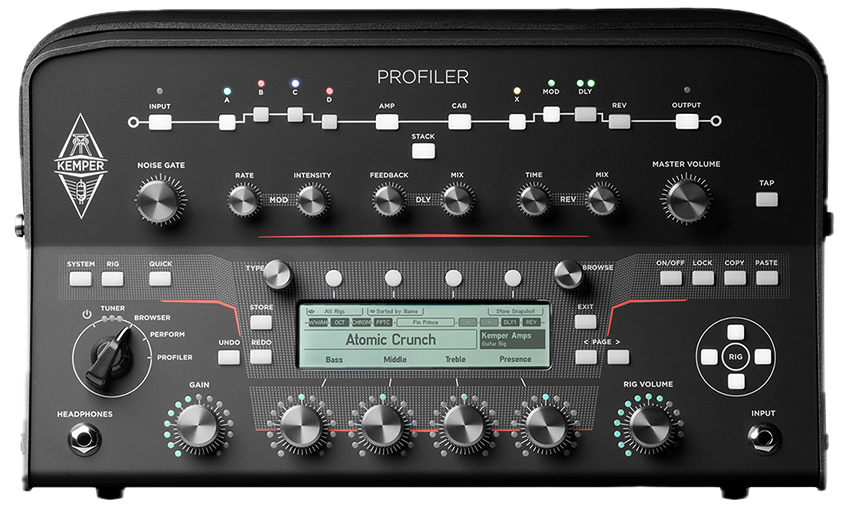
I’d planned to use my Kemper amp for this session — I’ve been playing it for six or seven years and I know it inside out. The idea was to load my sounds onto a USB stick and plug straight in at the studio.
Simple enough, except I found out there wouldn’t be a remote available, meaning I couldn’t switch between sounds during the session. So I wouldn’t have been able to alter the sounds between the verse, chorus or solo without stopping everything. That wasn’t going to work.
So I pulled out the Neural DSP Quad Cortex – a unit I’d reviewed a couple of years earlier but hadn’t touched since. I had to rebuild all my sounds from scratch, which meant a solid block of programming time before I could even start thinking about the music.
I set up a stereo rig — two amps, left and right, working together to create a wide, full sound. For “Bruises” I wanted something punchy and present, with a fuzz and octaver in the chain for the solo. For “Castle of Glass” I went for that shimmer quality — open, spacious, and a little otherworldly.
Then the device didn’t save any of it. Everything gone. Thirty minutes later, I was back on track and trying not to think about it.
Metropolis Studios
I couldn’t bring my own guitar on the plane, so I was trusting that a good instrument would be waiting for me at the studio. Fortunately it was — a Strat, which felt right at home for this kind of session.
The studio itself was Metropolis in London, and walking in knowing that Queen, Adele, and George Michael had all recorded there adds a weight to the room that you feel whether you want to or not. Studio A is apparently where the magic happens. I can confirm the atmosphere is real.
The group of musicians Mike had assembled was wonderful. Leona Nørskov Jørgensen was singing, Ellie Dixon was on bass and backing vocals. Sam Arrow on drums. And Charles Berthoud – who I actually recognised – was playing keys instead of his usual bass. A few of s got picked up at the hotel and brought over together, which immediately gave the day a good energy.
Recording with Mike
Mike arrived and immediately got to work figuring out how to arrange everything — and what struck me straight away was how he listened. He heard what everyone was doing, took on suggestions and ideas from the whole group, and shaped things with a real lightness of touch. He knew exactly what he wanted but made space for everyone to contribute. That’s a rare quality in a session leader.
We sorted our headphone mixes, got our sounds dialled in, and went from the top. In the room, all you could hear was the click track blinking away. It wasn’t until Mike mixed and mastered both tracks himself that it became clear what we’d actually built together.
“Bruises” came together beautifully — everything locked in, the arrangement felt right, and the downstrokes held up. “Castle of Glass” followed, with that shimmer sound sitting exactly where I wanted it in the mix. Both songs are available now on Mike Shinoda’s YouTube channel, and I’d really encourage you to go and listen to them.
A Day I Won’t Forget
After we’d wrapped, there was a group photo, a big red London bus, a lovely drink, and a lot of smiling.
Getting a message out of the blues from one of your childhood musical heroes is surreal enough. Actually getting to stand in a room with them, play music you grew up with, and contribute something meaningful to it — that’s something else entirely. Thank you, Mike. It was genuinely awesome.