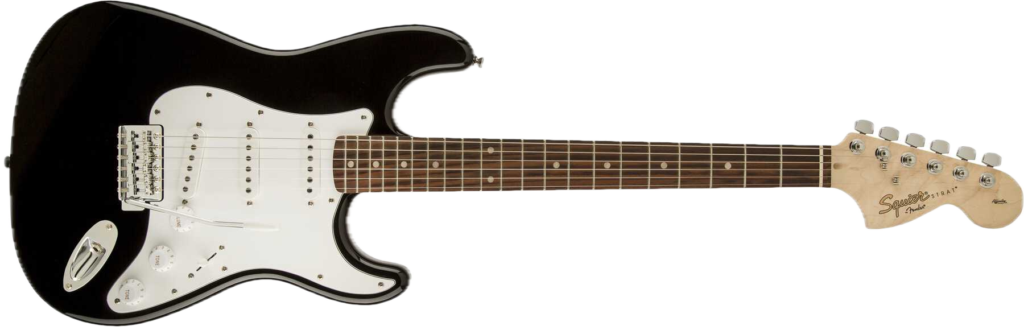
If you heard the guitar riff on Justin Bieber’s track “E.T.A.” and assumed it was laid down on some vintage Fender or boutique custom build, you’d be wrong. That unmistakable groove was played on a Squier Stratocaster — bought used for $99 with stock electronics, no setup, and five-year-old strings still on it.
The man behind it is Tom Strahle: guitarist, songwriter, and composer for film, TV, and video games.
His credits span from Call of Duty to Star Trek, and he’s collaborated with artists ranging from Skrillex to Justin Bieber.
I recently visited Tom at his LA studio to find out the story behind one of the most surprisingly lo-fi guitars in Hollywood — and what I heard completely changed the way I think about tone.
How Tom Found His $99 Secret Weapon
Tom’s love affair with cheap Squiers started at a friend’s recording session, where a battered Squier was sitting in the corner. He picked it up, plugged in, and felt something click.
“I grabbed it and went, wow, this is funky,” he told me.
He drove straight to Guitar Center and pulled every used Squier off the wall, plugging each one into a Fender Twin on a clean setting and running the same James Brown-style chord on the neck pickup — one by one — until he heard the one. When he found it, the sale was pretty much instant.
What he was chasing was a very specific sound: glassy, spanky, almost nasally — what he describes as “a guitar with a head cold.”
His main live guitar is an American Standard Strat with noiseless pickups, which sounds great but can’t deliver that particular lo-fi, 80s-inflected character. The cheap Squier, with all its imperfections, could.
The Story Behind the Justin Bieber Riff
When the call came in for Justin Bieber session material, Tom was given a simple brief: gospel and R&B vibes. He sat down with his $99 Squier and started generating ideas. The riff that ended up on the record was the seventh idea he came up with that night.
“I thought they were just going to take a four-bar phrase and loop it,” he laughed. Instead, they used almost five full minutes of his playing — largely unedited, in one take.
What makes the riff so compelling is Tom’s approach to harmony. He describes it as orbiting around E minor, but with some careful harmonic colour added:
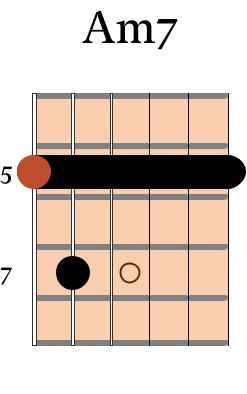
- Am7 (iv7 chord) — the minor four, which adds a darker, more soulful flavour than a major four would
- B7 (V7 chord) — rather than a straight B minor, the dominant seventh creates tension and a slightly Spanish, flamenco-inflected pull back to the tonic
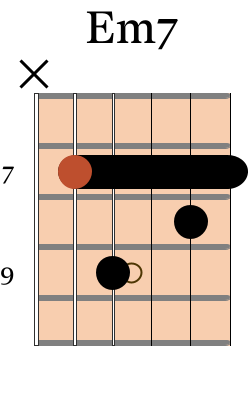
- Em7 (i7 chord) — the tonic chord of the key, which Tom embellishes with beautiful licks and melodies
- Cmaj7 (VI7 chord) — a classic move in gospel and R&B that lifts the progression before resolving
Here are the chords that Tom uses in the progression:
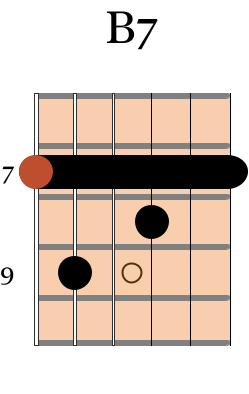
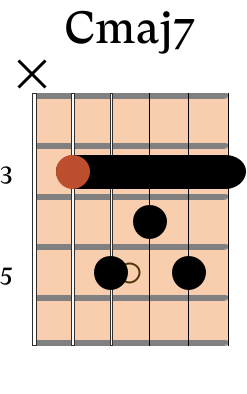
After playing the Cmaj7 he then moves back to the B7, before walking back up to the Em7 by playing an alteration of the B7 – a B7♭9.
Tom actually embellishes the B7 chord in this way throughout the progression – sharpening the five and flattening the nine at certain moments to add what he calls a bit of “special sauce” to the dominant chord
That final detail — the B7♭9 or B7#5 colouring — is what gives the riff its sophisticated, almost cinematic edge. It’s the kind of harmonic thinking you’d expect from a film composer, and it’s exactly what makes a simple E minor vamp feel like something far more layered.
When it comes to the embellishments that Tom adds in between chords, he takes a slightly unorthodox approach:
“I’m always trying to think like a horn player,” Tom said of his melodic phrasing. “That riff was a horn section to me.”
The Signal Chain: How to Get That Tone
The gear chain is remarkably simple for a professional studio recording:
Guitar → Volume Pedal → EBS MultiComp (subtle compression) → API EQ → Guitar Rig (Fender Twin sim) → Valhalla Plate Reverb
A few key points worth noting:
Tom keeps the compression subtle. The EBS MultiComp is always on, but only as a gentle glue — he avoids heavy compression because he wants the dynamics and humanity of the performance to come through. The slight variations in attack and sustain are what make the playing feel alive rather than processed.
The amp simulation is a Fender Twin via Guitar Rig — clean, open, and glassy. No overdrive or distortion. The Screamer plugin stays off.
The plate reverb is essential to the texture. Tom specifically reaches for Valhalla’s plate setting because it echoes the real plate reverbs of the 80s — a sound he’s chasing throughout much of his work.
When Tom played me the dry DI signal, it was genuinely revealing: the Squier sounds thin, a little dull, and raw. But rather than being a weakness, that lo-fi character is exactly what he’s building on. The signal chain enhances without masking it.
Thinking Beyond the Guitar
One of the most inspiring things I took away from my visit was how freely Tom experiments with cheap guitars — precisely because they’re cheap.
He has another Squier — an $80 one — strung with just three strings and tuned in octaves (all E strings), which he uses to create unusual textures for film and game scores.
Another is tuned to an African-style open tuning, similar to a low ukulele voicing. Because the guitars don’t cost a lot, neck tension and wear aren’t concerns — if a neck bends under unusual string gauges, he’ll just buy another one.
He also plays with very light strings — nines — which makes bends and expressive slides effortless and adds to that human, slightly imprecise quality that recorded guitar can sometimes lose.
The Most Important Part of the Signal Chain
Near the end of our conversation, Tom offered what might be the most useful takeaway for any guitarist — and it stuck with me on the drive home:
“The most important part of the signal path is the neural signal path — where you come up with a good idea. A bad idea with the best signal path and the best instrument is going to sound like a bad idea. But a good idea? You can make it work no matter what.”
It’s a straightforward point, but one worth sitting with. The Justin Bieber riff wasn’t great because of a $5,000 vintage Strat or a rack full of outboard gear. It was great because Tom had a strong musical idea, a clear harmonic vision, and the instinct to let the performance breathe rather than over-produce it.
The $99 Squier was just the messenger.
Key Takeaways
If you want to take something practical away from Tom’s approach, here’s what stands out to me:
Buy cheap guitars for specific sounds. Vintage and boutique instruments are great, but lo-fi character is hard to fake. A beat-up Squier can give you tones a pristine American Standard simply won’t.
Test guitars clean. Tom’s Guitar Center method — clean amp, neck pickup, same chord on every guitar — is a masterclass in evaluating raw tone without effects coloring your judgment.
Use altered chords deliberately. The B7♭9 and B7#5 tensions in the Justin Bieber riff are what elevate it from a simple groove to something cinematic. Understanding how to colour dominant chords is one of the most powerful tools in your harmonic vocabulary.
Keep compression subtle. The human feel of a performance is easily crushed by heavy compression. Tom’s approach — just enough to glue, never enough to flatten — is worth stealing.
Think like a different instrument. Tom’s habit of imagining horn lines while playing guitar is a brilliant way to escape guitar-centric thinking and find more melodic, flowing ideas.