There is something extremely satisfying about playing chords, melody, and bass all on one guitar — and that’s exactly what we’re going to do in this lesson. We’re going to build up a fingerstyle arrangement from scratch, adding one ingredient at a time, until we arrive at the intro of a song I wrote called “Lakeside.”
Let’s get into it.
First Things First: Tune to Open D
Before anything else, make sure you’re in open D tuning. This whole lesson is built around it, and it’s one of the most beautiful and rewarding tunings you can explore on the guitar. If you haven’t spent much time in open D before, this song is a great introduction.
Here is how each string of the guitar is tuned in open D:
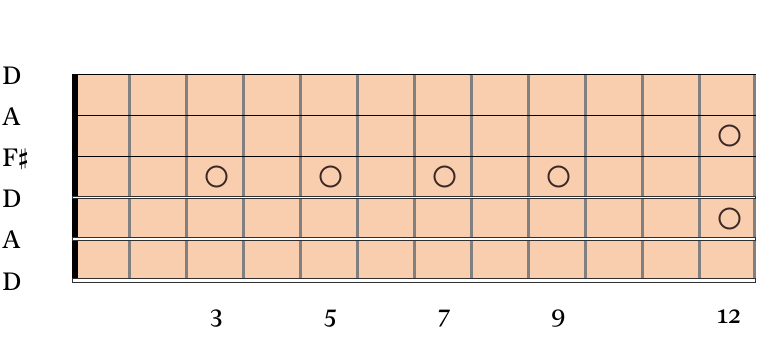
Once you’re tuned to open D, you can start simple and add in layers to create something beautiful by following these steps:
Level 1: Two Chords and a Picking Pattern
We start simple. The foundation of this arrangement is just two chords — an A and a D — built around strings five, four, and six with an open string on the second string rounding out the D chord. Nothing fancy yet, just a clean picking pattern with the thumb laying down the bass and the fingers handling the melody strings.
It’s a cool vibe already, but two chords on a picking pattern can only take you so far. So let’s start adding ingredients.
Level 2: Anticipation — One Note Changes Everything
The first ingredient is a single note added just before the D chord arrives. This technique is called anticipation — you’re implying the chord a beat early, and it creates a sense of forward movement that makes the whole thing feel alive.
We can do the same thing in the bass, playing fret four on string six just ahead of the chord change. It pulls you toward the D in a way that feels both natural and compelling.
Level 3: Spicing Up the D Chord — Turnarounds and Resolution
Once the anticipation is in place, the D chord can start to feel a little plain by comparison. The fix? A turnaround. We bring in a pull-off at the end of the phrase, and then turn the second chord into an E — giving us a V-I resolution from E to A that feels genuinely satisfying.
From there, we refine the picking pattern slightly — adding the index finger and rolling into the D chord with a little pull-off at the end. It’s a small adjustment but it adds a lot of character.
Level 4: Three-String Alternating Bass
Up to this point the alternating bass has been moving between two strings. Switching it to three strings immediately opens up the arrangement — it has a classic, rolling fingerpicking feel that gives the whole piece more depth and momentum.
With the three-string bass in place, we can also start sprinkling in occasional double stops — playing two strings at once for a brief chord feel. Use these sparingly and they add a lovely textural variation without overwhelming the arrangement.
Level 5: The Arpeggio — The Mark Knopfler Touch
This is one of my favorite ingredients. I call this the Mark Knopfler arpeggio — and once you hear it, you’ll know exactly why. It’s a simple ascending arpeggio, played just once, completely unexpected. If you’ve ever listened closely to “Romeo and Juliet,” you’ll recognize this move immediately. Knopfler uses it throughout.
On its own, the arpeggio sounds beautiful but doesn’t quite lead anywhere. So the question becomes: where do we take it? We need a high note to climax on — something that gives the arpeggio a sense of destination.
Here’s how I worked through the options:
- Major third — too cheesy
- Fifth — too bland
- Major seventh — gorgeous, and we’ll come back to this
- Nine — this is the one
The nine has that optimistic, hopeful quality that just feels right for this song. After the arpeggio climbs to the nine, we follow it with a descending run in A major — but rather than just going straight down, we play it down and back up again, which gives it much more life and energy.
Level 6: Moving Up the Neck — Bringing in the Major Seven
So far everything has been sitting in the same position on the neck. The final ingredient is movement — taking the arpeggio higher up the neck and landing on that major seventh we set aside earlier.
The major seventh up here sounds absolutely beautiful — richer and more resonant than it did lower down. With the arpeggio leading into it and the melody continuing higher up the neck, the arrangement suddenly has a dynamic range it didn’t have before. We end with the arpeggio climbing to the nine one more time, then resolve with a gentle landing back into the groove.
The Full Picture: “Lakeside”
And that’s it — that’s the intro to “Lakeside,” a song I wrote on a balcony in Italy with a view over one of the lakes. It was a genuinely wholesome experience, and I hope that feeling comes through when you play it.
Here’s a summary of everything we built up:
- Two chords and a picking pattern — the foundation
- Anticipation — one note that pulls you forward
- Turnaround and resolution — a 5-1 E to A that satisfies
- Three-string alternating bass — depth and momentum
- The Mark Knopfler arpeggio — ascending to the nine, followed by a scale run
- Moving up the neck — the major seven as the emotional peak
Open D is such a wonderful tuning to explore, and this song is one of the most enjoyable things I’ve written in it. I’d love to see you play it — share your video on Instagram and tag me at @pauldavidsguitar.