I’ve heard it a thousand times — “break out of the pentatonic box.” But what if I told you there’s still a whole universe of sounds hiding inside that box that most of us have never even touched?
That’s exactly what I discovered when I sat down with Dweezil Zappa at Hikari Studios in LA, and it’s one of the most exciting guitar conversations I’ve had in recent years.
Dweezil is a Grammy-winning guitarist and the son of the legendary Frank Zappa — a man who mastered some of the most technically impossible fretboard work in rock history. So when Dweezil has something to say about the pentatonic scale, you listen.
We actually crossed paths at the NAMM show — literally in the final minute before the lights went out. We got talking about how we each visualize the neck, and immediately knew we had to make a video together.
I was flying home from LA shortly after, so I’m incredibly grateful he made the time to sit down and talk through his approach to playing. What you’re about to read happened that fast — and I think it shows just how much passion Dweezil has for this stuff.
The Cluster Approach
The first thing Dweezil showed me completely reframed how I think about the pentatonic scale. Instead of running through a standard box pattern, the idea is to place just one note on each of three consecutive strings — creating what he calls a cluster.
So in the key of A minor, instead of playing these three notes from the first scale pattern:
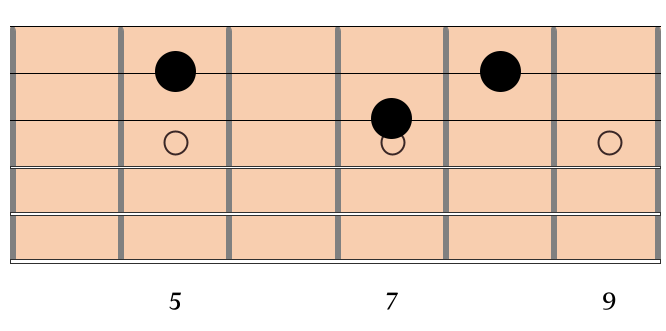
You take those three notes and play one on each string, like this:

It sounds deceptively simple, but the results are stunning. When you let those notes ring out independently rather than hammering through a scale run, you get this almost piano-like quality — rich, resonant, and full of space.
Notes that normally can’t coexist in a pentatonic phrase suddenly ring together beautifully. It’s still the pentatonic scale — just approached from a completely different angle.
Ascending and Descending Lines
Once you have that initial cluster shape under your fingers, the next step is moving it horizontally across the neck. If you know your A minor pentatonic scale on a single string, you already have everything you need — just take that same knowledge and shift the whole cluster shape through each position, like this:

When you play this idea, you are following the notes of the A minor pentatonic scale across the G string, and then adding the “clusters” on top of that on the B and E strings.
This idea also sounded beautiful when Dweezil reversed it, following these shapes back down to the starting position:

One thing that really caught my attention though, was when Dweezil reversed the direction of each individual cluster movement.
Going one way sounds great, but when you mix up the direction of each idea, it sounds otherworldly:

Your brain also has to work in a completely new way with these patterns — which is exactly the kind of challenge that builds real fretboard fluency.
Move It to Different Strings
Once you’re comfortable moving the cluster horizontally on one set of strings, the next step is transferring those shapes to different string sets entirely — and this is where some of the fingerings start to get genuinely challenging.
Here is what those clusters look like shifted down to the D, G and B strings:

While some of the shapes are similar to what we’ve already covered, others get surprisingly stretchy and angular. He described some of them as almost Allan Holdsworth-like in feel — and if you know Holdsworth’s playing, you’ll understand exactly what that means.
These aren’t comfortable, familiar pentatonic shapes. They require real attention and deliberate practice.
The payoff, though, is worth it. Dweezil suggested playing the shapes from both string sets simultaneously — one person covering the lower cluster while the other handles the higher one.
We tried it arpeggiated, rolling through the notes string by string, and the combination of the two layers was stunning. It also, as Dweezil pointed out with a smile, tells you very quickly how well your guitar is intonated.
Where It Gets Crazy
Here’s where things start to get seriously interesting. Take those same cluster shapes and move them vertically across the string sets as well.
You’re still playing only the notes of A minor pentatonic — A, C, D, E and G — but now you’re mapping them out diagonally across the entire neck, both up and down:

Add some delay or a few bass notes underneath, and this approach starts sounding less like scale practice and more like composition.
It’s a genuinely new way to find pentatonic sounds that most players have never thought about.
The ‘3 Sets of 2’ Approach
Dweezil visualizes the guitar neck as three sets of two strings.
The reason is elegant: whatever lick or shape you play on one pair of strings, you can repeat it almost identically an octave higher on the next pair up — because the tuning relationship is consistent across the neck (with the well-known exception of the G and B strings).
So in A minor pentatonic, you’d play a two-note-per-string shape on strings 6 and 5, then repeat the exact same fingering on strings 4 and 3, then again on strings 2 and 1, like this:

This might not sound so impressive at first, but once you stack these notes together and fill in the gaps, you end up with this:

Same lick. Three octaves. Instant neck coverage without having to memorize a dozen different patterns.
The ear hears something rich and evolving, but you’re really just playing the same four notes in three different octaves. It’s a beautiful illusion — and a practical system for unlocking the full neck.
But here’s the thing: this system only works if you actually know where your octaves are. And that’s where a lot of players hit a wall.
Octaves and Unisons
Dweezil made an honest admission here — even at his level, he doesn’t have every single note on the neck memorized in every position. If you asked him to find a B flat on the G string cold, he’d work it out by finding a B first and adjusting from there.
And if that’s true for someone with his experience, it’s no surprise that so many players get completely lost the moment they’re asked to play in an unfamiliar key or position. Dweezil’s solution is to make octaves and unisons your anchor points.
The guitar is unique in that the same note exists in so many different places on the neck. Most players know this in theory, but haven’t actually mapped it out in a way that becomes instinctive. Dweezil’s approach is to find every occurrence of a given note — its octaves and its unisons — and use those as visual and physical landmarks.
Once you know where your A is in every position, finding the notes around it becomes dramatically easier.
Exercise: Octaves and Unisons
Knowing the concept is one thing — drilling it into your fingers is another. Here is an exercise that Dweezil recommends, where you cycle through octaves and unisons for a target note like this:

From A, move it up a half step to B flat, then up to B, C and so on. That’s where it gets really interesting — your brain suddenly doesn’t trust itself, and that’s exactly the point. Push through that discomfort and you will build really solid fretboard knowledge.
Dweezil also practices these exercises using just his fretting hand, moving across the neck without picking. He was upfront about how brutal it feels at first, but the payoff is significant: better finger tone, more confident position shifts, and a much clearer mental map of the fretboard.
A More Fun Exercise
Once you’ve got the octave and unison cycle in your fingers, Dweezil suggested a simple but effective twist: add a leading note in front of each octave landing.
Suddenly a dry technical exercise becomes something melodic — it reminded me a little bit of a guitar riff you might hear in a Yes song.
It keeps the practice engaging while still doing all the same fretboard mapping work under the hood. If you’re someone who struggles to stick with exercises, this is the version to use.
The One String Approach
We wrapped up with something beautifully simple. Dweezil talked about how, as a kid, he learned the neck by droning a single note and then just listening for which other notes sounded good against it — finding the tension and release, hearing the pentatonic tones emerge naturally string by string.
That instinct — recognising that the same shapes repeat everywhere, that there are really only five positions cycling across the neck — is what gave him his visual system in the first place. Play a single pentatonic line on one string, let it breathe, and listen to what it tells you.
Near the end of our session, Dweezil’s guitar — fitted with a Sustainiac pickup — brought this idea to life in the most vivid way possible. I held a chord while he played a pentatonic line on top, and the result was just everything. Full, lush, completely alive. Sometimes the simplest ideas, with the right guitar, say it all.
The Takeaway
What struck me most about Dweezil’s approach is how it combines visual clarity with musicality. The cluster shapes, the three-string-pair concept, the octave anchoring — these are all tools that give you freedom, not more boxes to get trapped in.
Everybody says break out of the pentatonic box. But as Dweezil put it perfectly: sometimes there’s still more in the box that we’ve never discovered.
If this kind of deep-dive into the fretboard is your thing, my course Electric Elevation goes even further into building this kind of full-neck fluency. Check it out here.
And make sure you follow Dweezil Zappa on YouTube — his tone and technique are truly in a class of their own!