In 1954, Leo Fender introduced an instrument that would become the best-selling, most iconic electric guitar of all time: the Fender Stratocaster. Seventy years later, his design remains largely unchanged—a testament to how perfectly he got it right the first time.
Today we’re exploring the complete evolution of the Stratocaster during its “golden era”—the Pre-CBS period from 1954 to 1965. These 11 years saw the Strat transform from a Western Swing curiosity into the defining instrument of rock and roll, and the guitars built during this period remain the blueprint for every Stratocaster sold today.
The Birth of the Stratocaster: Why Leo Built It
By the early 1950s, the solid-body revolution was already underway, led by Leo Fender’s first production model: the Broadcaster, soon renamed the Telecaster.
Western Swing virtuosos like Jimmy Bryant were among the first to recognize its potential, but these working professionals were also its first critics.
The complaints were specific and practical. The sharp edges dug into players during long sets, causing discomfort after hours of performance.
The limited tonal options—just two pickups with basic switching—left players wanting more sonic variety. And perhaps most importantly, the primitive bridge offered no vibrato capabilities, limiting expression.
Leo Fender listened. In his small California workshop, he began sketching the Telecaster’s natural evolution—a guitar that felt better, sounded broader, and offered players a new level of control.
The Synchronized Tremolo: The Game-Changer
Western Swing players like Bill Carson had been pestering Leo for a way to mimic the crying slide of a pedal steel guitar. Existing vibratos like the Bigsby were clunky and unstable, causing tuning nightmares.
Leo’s solution was the Synchronized Tremolo – a bridge system that would become one of the most influential guitar innovations ever created. Combined with body contours for comfort, a double cutaway for upper-fret access, and three single-coil pickups for an entirely new tonal palette, the Stratocaster officially entered production in October 1954.
1954: The Birth Year
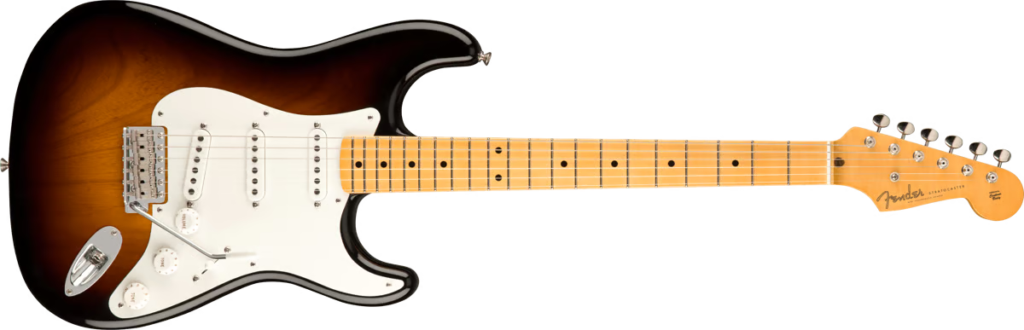
The original 1954 Stratocaster featured an elegant ash body finished in a two-tone sunburst that faded from yellow to black. A thin nitrocellulose lacquer allowed the wood to breathe while providing protection.
But what really set it apart were the revolutionary body contours that made it comfortable to play for hours, combined with a double cutaway design that gave players unprecedented access to the upper frets.
The neck was a chunky one-piece maple affair with a U-profile that filled your hand. The truss rod was inserted from the back and sealed with what would become the iconic “skunk stripe”—a walnut strip that covered the channel.
The maple fretboard featured simple black dot inlays, and serial numbers were stamped on the back tremolo cover plate. Early examples from 1954 had serial numbers in the double digits, making them incredibly rare today.
Three Alnico III pickups established the bright, dynamic template we still recognize today as “the Strat sound.” The single-ply pickguard attached with just eight screws, and the knobs and covers were made from fragile Bakelite plastic that would prove problematic.
A simple round string retainer kept the strings in their nut slots. All the hardware came in chrome, and the revolutionary Synchronized Tremolo bridge completed the package.
Despite arriving just as rock and roll was taking shape with artists like Bill Haley, the Strat was initially seen mostly in the Western Swing scene, as these were the players who’d helped develop it. Early sales actually lagged behind its older and cheaper sibling, the Telecaster. It wasn’t an immediate commercial success.
1955: Refinement Begins
In 1955, Fender made subtle but important refinements to production. Guitars often came out slightly lighter in weight, and the neck profile began its gradual shift from the chunky U toward a softer, more refined shape. Production techniques improved across the board, creating more consistency between individual instruments.
Rock and roll was rising fast. Bo Diddley, Chuck Berry, and Fats Domino were defining a new sound, and the Strat suddenly found itself in the crossfire of a musical revolution.
While hollowbody guitars remained popular with jazz players, the “solid-body boom” was in full swing. The Telecaster and Gibson Les Paul had already established themselves, but as the music evolved, the Strat’s futuristic curves began catching the eye of early rockers.
Young players wanted something that looked modern and felt comfortable, and the Strat delivered both.
1956: A New Wood, A New Feel
By 1956, significant changes appeared.
Alder replaced ash as the primary body wood for sunburst finishes. This change wasn’t just aesthetic—alder was more readily available, cheaper, and easier to work with in the factory.
For those who believe in tonewoods (and there are compelling reasons to), alder added a touch more midrange warmth compared to the brighter ash.
The neck profile continued its evolution toward the soft V shape that many players still swear by today. And up at the headstock, the simple round string retainer evolved into the now-familiar butterfly string tree, improving string angle and tuning stability.
Rock and roll was exploding. Elvis Presley, Carl Perkins, and Little Richard were hitting their stride. The guitar was gaining serious traction with young players who wanted comfort, style, and a modern aesthetic.
The Strat wasn’t just a tool anymore—it was becoming a symbol.
1957: A Defining Year
Then came 1957—the year that would mark a significant turning point for the Stratocaster’s popularity.
The neck profile settled into a bold, unmistakable V-profile—strong, resonant, and beloved by collectors today. Many consider this the most comfortable vintage Strat neck ever made. Fender also abandoned the fragile Bakelite plastics that had caused problems since day one, switching to ABS knobs and covers in a brighter white that proved far more durable.
But the most important change came in the pickups. Fender made the jump from Alnico III to Alnico V magnets, and the difference was immediately noticeable: more output, more clarity, more punch. This tonal shift would define what we think of as the classic Stratocaster sound.
Many players and collectors consider the 1957 Strat the crown jewel of the decade. The combination of the V-profile neck, brighter plastics, and more powerful pickups created what many feel is the perfect Stratocaster.
A huge breakthrough happened when young Buddy Holly appeared on The Ed Sullivan Show holding a Stratocaster. Distinct from the big-bodied jazz guitars of the older generation, the Strat looked like an instrument of the future.
For the first time, the guitar became a symbol of youth culture. If you wanted to play rock and roll, you wanted a Strat. Buddy Holly made the Stratocaster aspirational.
1958: A Splash of Color
In 1958, the Strat got more colorful.
The two-tone burst expanded to a vibrant three-tone sunburst: yellow in the center, shifting through red, then fading to black. It was more visually striking and decidedly more modern. The neck also slimmed down further, moving toward a C or slim D profile that felt faster and more contemporary in players’ hands.
The Strat proved it could handle more than Western Swing and early rock and roll. Ritchie Valens—at just 17 years old—used it to drive the thumping, aggressive beat of “La Bamba.”
The Strat’s clarity allowed those percussive Latin rhythms to translate into rock and roll, proving the instrument had versatility that went far beyond its country roots.
1959: On the Cusp of Change
The year 1959 began with heartbreak that shook the music world.
As 1959 opened, the Stratocaster had reached a point of refinement. Specifications remained largely consistent with 1958—the three-tone sunburst finish, slim neck profile, and Alnico V pickups were all in place. The guitar was perfected, poised, and ready for its most radical design shift yet.
But the year began with heartbreak that shook the music world.
On February 3rd, 1959—forever known as “The Day the Music Died”—a plane crash in Iowa claimed the lives of Buddy Holly, Ritchie Valens, and J.P. “The Big Bopper” Richardson.
In a single night, the Stratocaster lost two of its first icons.
Yet the sound these artists pioneered had already sparked a fire that wouldn’t be extinguished. As the 1950s came to a close, rock and roll was evolving, spreading, and the Stratocaster was about to leave the maple-neck era behind and enter a bold new chapter.
1960: A New Era—The Rosewood Years
By 1960, Fender made its most dramatic change yet.
Fender retired the one-piece maple neck across all instruments in 1960, introducing a two-piece design with a thick “slab” of Brazilian rosewood as the fretboard:
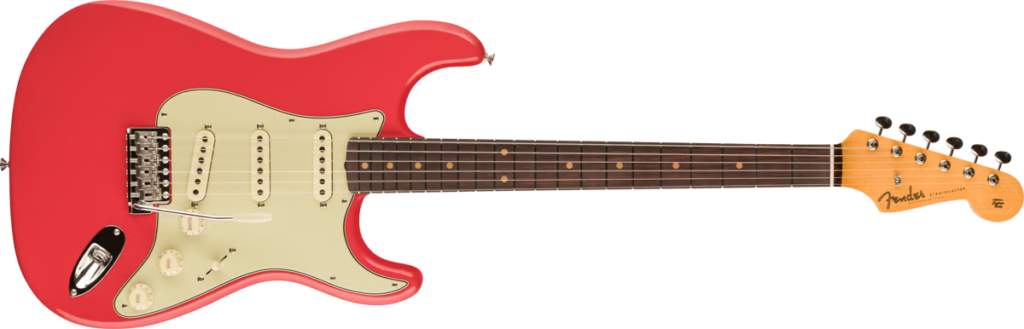
The truss rod was now inserted from the front and then covered by the glued rosewood, eliminating the need for the skunk stripe on the back of the neck. The simple black dot inlays were replaced with “clay” dots—actually plastic, but their appearance gave them the name.
Players immediately noticed a slightly mellower sound. More midrange warmth emerged, with less top-end brittleness. Some players preferred it, while others missed the maple brightness. As with most things in guitar tone, it’s highly subjective.
There were also a number of further changes made to the design:
The pickguard evolved into a three-ply celluloid construction held on with 11 screws instead of the original eight. Over time, these pickguards would famously age into that beautiful mint-green tint that collectors love today.
The neck became even more refined, shifting toward a thinner C-profile that felt modern and fast under the fingers. This was a clear departure from the chunky profiles of the mid-’50s, catering to players who wanted speed and comfort.
Fender also started offering custom colors straight from automotive paint catalogs, including Surf Green, Lake Placid Blue, Olympic White, and the most iconic of all—Fiesta Red. These vibrant finishes gave players a way to stand out visually, moving beyond the traditional sunburst that had dominated since 1954.
The British Connection
When American rock and roll softened, a massive shift occurred across the Atlantic. After the UK lifted its import ban on guitars, Hank Marvin of The Shadows brought in one of the very first Stratocasters to reach British soil—a Fiesta Red model.
His echo-drenched hits like “Apache” defined the sound of British guitar instrumental music. Future legends like Eric Clapton, David Gilmour, and George Harrison saw this red guitar and decided: that’s what a rock star looks like.
1961: Color Tweaks and Subtle Shifts
In 1961, refinements continued:
Fender strengthened their red dyes since earlier sunburst finishes had a troublesome habit of fading to pink or orange over time. Otherwise, the Strat of 1961 stayed remarkably true to the 1960 design. Brazilian rosewood slab fretboards continued, three-ply mint-green pickguards remained standard, and the thin C-profile necks felt fast and modern.
The new decade introduced an even bigger wave of reverb and a new genre: Surf Music, and the Strat was essential to the sound.
Dick Dale, the self-proclaimed “King of the Surf Guitar,” pushed the instrument to its limits with aggressive playing and heavy reverb. The Ventures defined instrumental surf rock with their clean, melodic approach, while The Beach Boys brought surf music to the mainstream. If you wanted to play surf music, you had to play a Strat—there was simply no substitute.
1962: Veneer Boards Take Over
In 1962, a practical production change occurred:
The thick slab rosewood gave way to a thinner curved veneer. This was a practical decision that saved expensive Brazilian rosewood while making production more sustainable as demand grew.
The change didn’t alter the feel or appearance significantly—most players couldn’t tell the difference between a slab board and a veneer board just by playing.
To many players, 1962 marks the beginning of the “classic early-60s Strat”—the sound and feel most associated with vintage Stratocasters. The refined specs, the rosewood fretboard warmth, and the powerful Alnico V pickups had all come together into something special.
By 1962, the guitar had infiltrated mainstream pop. It wasn’t just for surf or rockabilly anymore—it became the sound of the radio. And while the Strat was dominating the waves with Dick Dale and The Ventures, something very different was happening in Chicago.
Curtis Mayfield—a major influence on Jimi Hendrix—was taking the Strat in a completely different direction with The Impressions.
On hits like “Gypsy Woman,” he used the Strat’s clear, bell-like neck pickup to weave complex, piano-like chord voicings around his vocals.
So while it is often associated with rock, the Strat was also making serious inroads into R&B and soul. The instrument’s characteristic “quack” offered a percussive funkiness that rhythm players in backing bands loved.
1963: Stability and Consistency
1963 saw continued refinement but no major changes. The curved veneer rosewood fretboards continued, along with three-ply mint-green celluloid pickguards and thin C-profile necks.
Alnico V pickups remained standard, and players could choose between three-tone sunbursts and an expanding palette of custom colors.
The Strat had reached a sweet spot—refined, perfected, and ready for the explosion that was about to hit.
1964: The Last Great Pre-CBS Year
Fast-forward to 1964—the British Invasion was in full swing, and this would be the final full year before corporate ownership changed everything.
The celluloid mint-green pickguards were phased out and replaced with more stable white PVC that proved more durable and less prone to shrinkage and cracking.
Fender also changed the pickup wire from Formvar (used since 1954) to Plain Enamel, which warmed the tone just a touch—subtle but noticeable to experienced ears.
Body contours were softened slightly for a more comfortable, refined feel. And perhaps most symbolically, the iconic “spaghetti” logo made its exit, replaced by the gold “transition” decal that signals the end of an era.
This was the final full year before the corporate shift that would change Fender forever. Many collectors consider 1964 the last “pure” Pre-CBS year, and these guitars command premium prices. The “L-series” serial numbers (L prefix) are particularly desirable among collectors.
The British Invasion was underway. The Beatles and Rolling Stones were changing music forever. Garage rock was forming across America. Guitar-driven music dominated the charts.
Strat tones were everywhere—from London studios to American garages. The guitar had become ubiquitous in rock music.
1965: The End of an Era
[In January 1965, Columbia Broadcasting System (CBS)—the giant media company—officially purchased Fender, marking the start of the “CBS Era.”
Early 1965 guitars still held pure Pre-CBS specifications and remain indistinguishable from 1964 models, making them highly collectible.
But once the CBS takeover took full effect later in the year, the changes were unmistakable: the large headstock appeared, “F” stamps were added to neck plates, new Schaller diamond-shaped tuners replaced the originals, and production ramped up dramatically.
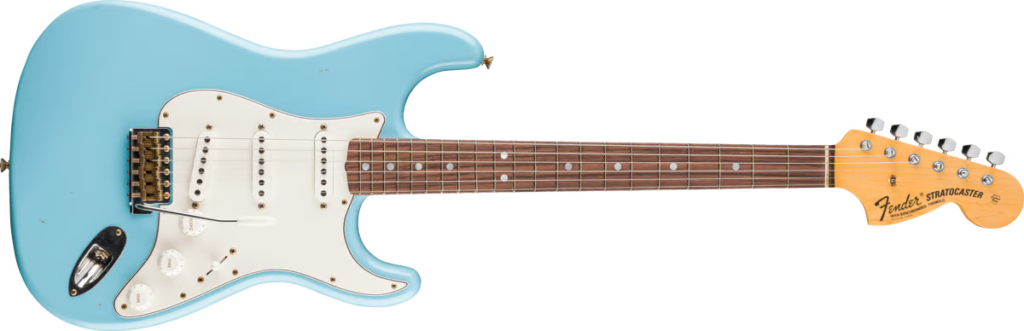
As production scaled up, changes prioritized efficiency and cost-saving. The traditional nitrocellulose lacquer was largely phased out, replaced with a heavier, glossier polyester finish that was more durable but less resonant according to many players. C
Quality control shifted as the tight craftsmanship of small-shop production gave way to mass-market variation, creating more inconsistency between individual instruments. Some argue quality “fell off a cliff,” while others say the complaints are overblown.
Did Quality Really Drop?
The debate rages on. CBS-era Strats are definitely different, but whether they’re truly inferior is subjective.
The shift occurred during one of the most powerful surges in American rock music—the blues revival, folk-rock explosion, and psychedelic era.
And in that very moment, the world was introduced to Jimi Hendrix – a guitarist who would cement the Strat’s legacy for all time.
Jimi Hendrix grabbed a CBS-era Stratocaster, turned it upside down as he was left-handed, and changed music forever.
The guitar became an extension of his voice. He coaxed sounds from it that no one had imagined possible—feedback, distortion, wah, and the whammy bar used as an expressive tool rather than a gimmick.
If Hendrix could make magic with a CBS Strat, maybe the complaints about declining quality are a little overstated?
The Stratocaster’s Lasting Legacy
The most remarkable thing about the Stratocaster? A guitar designed in 1954 is nearly identical to what we buy today in 2025.
Think about that. The Telecaster and Stratocaster got it so right that seven decades later, the fundamental design hasn’t changed. The body shape, pickup configuration, bridge system, electronics are all essentially the same.
This is almost unprecedented in industrial design.
Imagine if we were still building cars, computers, or phones to 1950s specifications. But with guitars, Leo’s vision was so perfectly executed that it remains the standard.
No matter how many hands it passed through—from Western Swing to Surf, from Rock ‘n’ Roll to Soul, from Buddy Holly to Hendrix—the Strat remained mostly the same but always found a way to be a part of music and redefine it.
Seventy years later, Leo’s vision still works. There’s something about a Strat that just feels right in your hands. It invites you to play and makes you want to chase the sound that hooked you in the first place.
That’s the story of the Stratocaster. And it’s far from over.