Imagine wood older than the Great Pyramids. Older than Stonehenge. Wood that was buried in the ground for more than seven millennia before anyone thought to turn it into a guitar.
That’s exactly what Derk Jan Lievers of Dejawu Guitars has done — and the result might just be one of the most extraordinary instruments I’ve ever had the pleasure of playing.
The Wood That Outlasted Civilisations
The story begins in the Chinese countryside, where Derk Jan’s partner and fellow luthier Wu Dongming unearthed an ancient tree trunk. At first, they assumed it was a few hundred years old — maybe three or four hundred at most. Curious, they sent a fragment to a laboratory in Germany for carbon dating.
The result stopped them in their tracks.
“Dear Mr. Lievers, we found out this wood is about seven and a half thousand years old.”
To put that in perspective: we’re talking about the Neolithic period — a time before written history, before the wheel was in widespread use, before virtually every monument we associate with the ancient world. The wood predates all of it.
How did it survive? The trunk had been completely submerged in mud, cut off from oxygen, which effectively put the aging process on pause. When it was finally pulled from the ground, it was dense, solid, and — remarkably — still workable.
The grain turned out to be exceptionally tight, which luthiers consider a strong indicator of excellent acoustic properties. And the species? Maple. You can even spot hints of bird’s-eye figuring in the grain if you look closely.
What’s also immediately striking is the colour. A rare combination of nutrients in the soil has given the wood a stunning, naturally developed dark brown hue that you simply couldn’t replicate artificially. To preserve it, Derk Jan applied multiple ultra-thin layers of hand-polished nitrocellulose lacquer — enough to protect the wood without dampening its resonance.
Building the Holy Grail Guitar
Derk Jan describes the project simply: “I tried to make a little bit of a Holy Grail guitar.”
The build follows traditional archtop construction — everything hand-carved from a single piece of wood, with a book-matched top. Building from one piece is a deliberate choice: it allows the wood to vibrate more freely, producing a more complex and dynamic sound.
The neck is also made from the same prehistoric maple, though given the obvious stakes, Derk Jan took the precaution of adding two carbon fibre reinforcement rods for stability. The body is elegantly trimmed with a seven-ply young maple binding, which creates a beautiful contrast against the ancient dark wood.
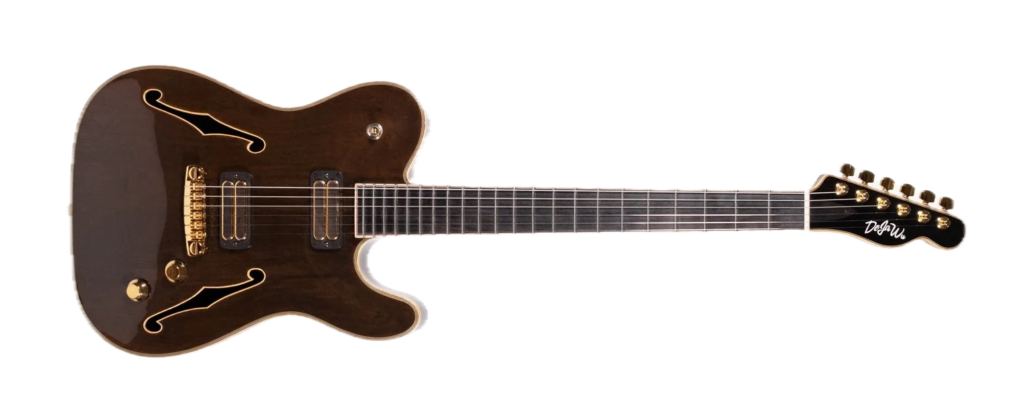
One of the more ingenious aspects of the construction is how feedback is handled. Rather than using a full-length centre block — the standard approach in semi-acoustic building — Dejawu uses a square centre block positioned only at the bridge. The centre of the top maintains its original thickness while the surrounding wood is carefully carved away by hand, meaning there’s no tension on the top and no tendency to warp or deform over time. It eliminates feedback entirely while keeping the guitar’s acoustic properties fully intact.
The woodwork alone takes six to eight weeks. After that comes the finishing, hardware, and final assembly — a labour-intensive process for any archtop build, but one that carries extra weight when the raw material is this extraordinary.
For the electronics, Derk Jan commissioned a custom set of Harry Häussel Double-TE ST-A5 pickups — one at the neck, one at the bridge — wound with original Stratocaster-style wire and fitted with Alnico 5 magnets for a full, round, and clear tone.
In a particularly lovely touch, the pickup covers are finished with the same ancient maple used throughout the guitar. The switching is handled by a Free-Way 6-position toggle, which — combined with a push/push tone pot — gives access to series humbucking, inner single coil, and outer single coil configurations. It’s a deceptively versatile instrument.
Key Specs at a Glance
- Builder: Dejawu Guitars (Derk Jan Lievers & Wu Dongming)
- Model: T-Ultimate Neolithic No. 1
- Wood: 7,500-year-old Neolithic sinker maple (carbon dated in Germany)
- Construction: Hand-carved hollow body archtop, one-piece build, book-matched top
- Neck: Same prehistoric maple, with two carbon fibre reinforcement rods
- Binding: Seven-ply young maple
- Weight: 2,600 grams
- Pickups: Custom Harry Häussel Double-TE ST-A5 (Alnico 5, original strat wire)
- Switching: Free-Way 6-position toggle + push/push tone pot
- Finish: Hand-polished nitrocellulose lacquer
- Style: Semi-acoustic / hollow body — Telecaster-inspired aesthetics, jazz guitar feel
Playing It Live in the Stravinsky Auditorium
The Montreux International Guitar Show gave me the perfect setting to try the guitar — the Stravinsky Auditorium, a venue with a naturally beautiful acoustic character. Paired with a 45 watt Precious Tone tube amp, the guitar had every opportunity to show what it was made of.
My immediate impression? Surprisingly balanced. Sweet, warm, and deeply resonant — you feel it vibrating against your body as much as you hear it through the amp. And despite the premium hardware and solid construction throughout, it’s remarkably light: the T-Ultimate weighs just 2,600 grams, which makes it genuinely effortless to wear for a full set.
The neck is wider than a typical Telecaster, which pushes the feel firmly into jazz guitar territory, and the depth of the body amplifies that sense of acoustic richness.
Does it sound better because of its age? That’s a harder question to answer. Derk Jan himself admits he hasn’t done a direct A/B comparison with modern maple. What he does point to is the density of the grain — tight growth rings that developed over a very long life — as a likely contributor to its tonal qualities. The science of tonewood is always debatable, but the density argument has more grounding than most.
Honestly? I don’t really care whether it sounds different. It’s all about what it does to the player — just knowing it’s so old makes it incredibly enticing to pick up. And that’s all you want from an instrument. It has to get the most out of the person playing it.
And sitting in that auditorium, holding something that had been silent underground for 7,500 years and was now singing through a tube amp in Montreux — it’s hard not to feel something special.