Four years ago, a guitar with built-in effects seemed like a novelty—something that might compromise the purity of acoustic tone for party tricks. Now, Yamaha has released an updated version of their TransAcoustic guitar with improved reverb, chorus, delay, and most notably, an onboard looper.
The question isn’t whether the technology works—it’s whether it belongs on an acoustic guitar at all.
After a week of living with this instrument, the answer is more complicated than expected. This isn’t a gimmick guitar disguised as a professional instrument, but it’s also not quite the acoustic purist’s dream. It exists somewhere in between, and that’s both its strength and its challenge.
What Makes the TransAcoustic Guitar Different
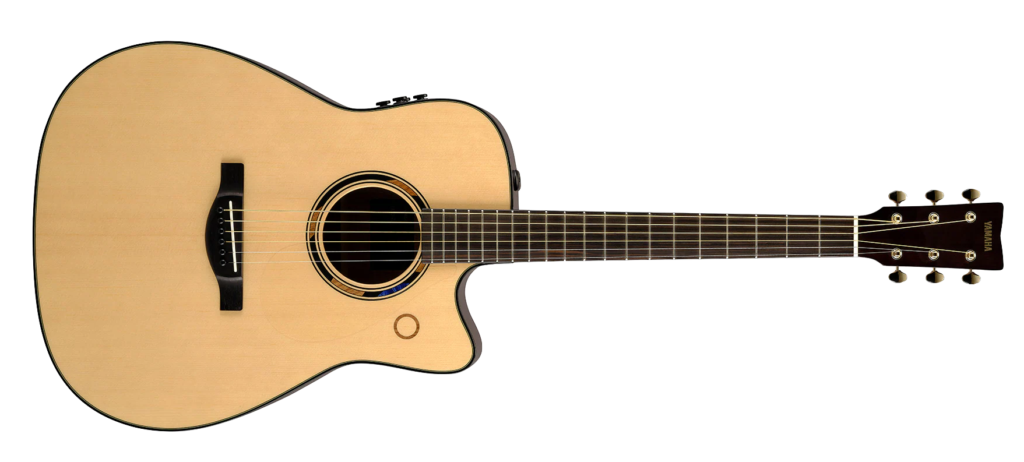
At first glance, the TransAcoustic looks like any other dreadnought acoustic—solid Sitka spruce top, mahogany back and sides, professional build quality. The only visible clue to its electronic nature is a small control ring near the soundhole.
But inside, the guitar contains something unusual: two actuators that physically vibrate the guitar’s body to produce effects. This isn’t a pickup system running effects through a processor and then back through a speaker. The guitar’s actual wooden body becomes the reverb chamber, chorus effect, and delay unit.
When you turn on the reverb, you’re not hearing a digital simulation played through a transducer—you’re hearing the guitar’s body resonating in ways it normally wouldn’t. It’s a fundamentally different approach than traditional acoustic-electric systems with onboard effects.
The result?
Effects that blend more naturally with the acoustic tone because they’re coming from the same source as your playing. There’s no sense of two separate sounds—acoustic guitar plus digital effect—competing for your attention.
The Core Effects: Reverb and Chorus
The TransAcoustic’s foundation rests on two effects that were present in the previous generation: reverb and chorus. Both have been significantly improved in this iteration.
Reverb
Turn the guitar on, rotate the dial, and reverb blooms around your playing. Unlike the previous model, this reverb sounds fuller and more balanced. It doesn’t sit on top of your dry signal like a separate effect—it integrates with it, creating the impression of playing in a naturally reverberant space.
You can dial it in from subtle (just enough to add dimension) to dramatic (swimming in ambience). The tone and length are adjustable through the companion app (more on that below), though the onboard dial handles most practical adjustments.
The reverb never overwhelms the fundamental acoustic character of the instrument. Even at maximum settings, you still hear a guitar, not an effects processor pretending to be a guitar.
Chorus
The chorus effect adds width and shimmer to the sound. Like the reverb, it’s been refined since the previous generation—slightly sweeter, more musical, less obviously processed.
Chorus on acoustic guitar isn’t everyone’s preference, but the implementation here works. At subtle settings, it adds a gentle doubling effect. Pushed further, it creates more pronounced movement and depth.
Blend reverb and chorus together and you get a lush, atmospheric sound perfect for ballads or ambient playing. Pull both effects down to zero and reality hits—you’re back to a pure acoustic sound with no coloration.
The New Addition: Delay
Delay represents new territory for the TransAcoustic line. The actuators now create repeating echoes of your playing, with adjustable feedback and timing.
For me, delay on an acoustic guitar doesn’t rank high on the essential effects list. I think that it can sometimes sound busy and distract from the natural decay of acoustic notes. But there are applications where it shines, particularly when used with the looper (more on that shortly).
You can tap tempo the delay to sync it with your playing, though the app could benefit from more rhythmic subdivision options (dotted eighths, dotted quarters, etc.). For now, you’re limited to straight note divisions.
The Game-Changer: The Onboard Looper
Previous attempts at building loopers into acoustic guitars have been disappointing—menu diving, boot-up delays, mediocre sound quality, limited functionality. The TransAcoustic’s looper succeeds where others have failed, and it comes down to three critical factors.
Factor One: Immediate Access
Turn the guitar on. Click “Loop.” Start playing.
That’s it.
There’s no boot sequence, no menu navigation, no waiting. The threshold between having an idea and capturing it is essentially zero. This matters enormously for creativity, as when inspiration strikes, you don’t want to fight with technology.
After a week of having this guitar in the living room, the low barrier to looping meant constant experimentation. Quick musical ideas got captured that might have died if I’d had to wait for a computer to boot up or a looper pedal to be plugged in.
Factor Two: Sound Quality
The looper sounds surprisingly good—good enough that playback can be confused with actual guitar playing. The bass response is deep, the frequency range is full, and while there’s some of that characteristic digital “piezo” quality, it’s minimal.
This creates a genuine two-guitarist illusion when overdubbing. The loop sits in the mix like another instrument, rather than sounding like a degraded copy of your original playing. You can also adjust loop volume to balance it with your live playing.
Factor Three: Smart Implementation
Here’s the genius part: the looper uses threshold-based recording. Instead of hitting record and starting to play (which creates awkward gaps), you hit record and the looper waits. When you start playing—which causes the signal to cross a certain threshold—recording begins automatically.
Over 100+ loops, this system missed maybe three or four times, typically when I was playing very quietly with fingerpicking patterns that started with just the thumb. When you are aware of this limitation, you can work around it—and for the vast majority of playing, it captures the first note perfectly.
How It Works in Practice
Activate loop mode and clear any existing loop. Press record and start playing and the loop captures your performance. Press record again to close the loop. Now you can overdub additional layers.
It’s genuinely free-form—there’s no click track or predetermined length. The loop length is determined by your first pass. This flexibility encourages musical experimentation rather than metronomic precision.
Creative Applications: Delay on Loops
One creative application makes the delay feature more appealing: you can add delay only to your lead line while leaving the loop clean.
Record a rhythm part with no delay and close the loop, then engage delay.
Now your melodic lines have spatial depth while the underlying loop stays focused and clear. Tap tempo the delay to match your loop’s groove.
This separation of effects between loop and live playing opens interesting textural possibilities. The delay becomes a lead enhancement tool rather than an always-on effect.
The Limitations of Basic Looping
For all its strengths, the TransAcoustic’s looper is deliberately basic. It adds layers. That’s it.
There’s no undo function—if you make a mistake on an overdub, you’re starting over. There’s no ability to stop and start individual loops, no reverse function, no half-speed playback. You can’t save loops for later recall.
This simplicity has implications.
The guitar probably isn’t ideal for live performance use. Building complex loop arrangements on stage, where mistakes matter and you can’t easily start fresh, would be stressful. The looper lacks the features professional live loopers need.
But for home use and creative exploration?
The simplicity becomes an advantage. There’s nothing to learn, nothing to configure. You loop, you overdub, you clear and start again. The creative process stays musical rather than technical.
The Charging Situation
The guitar uses a proprietary magnetic charging cable. The magnet snaps satisfyingly to the guitar’s jack, which is clever. What’s not clever: the cable is USB-A on the other end, not USB-C, and it’s short.
Today, when virtually everything uses USB-C, adding another proprietary cable to your collection feels unnecessary. Want to play while charging? The cable length makes this awkward. Going to a friend’s house? Better remember that specific cable.
Yamaha claims 5.5 hours of battery life, though actual use suggests it might be longer—perhaps the rating only counts active sound production. Regardless, the charging situation is a mild but persistent annoyance.
The App: Useful but Uninspiring
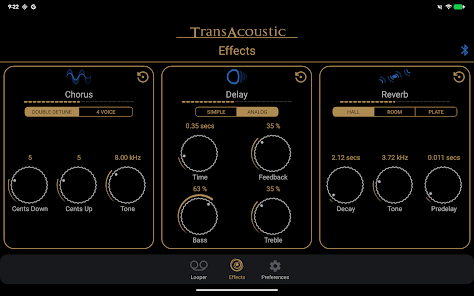
A companion app provides deep editing of effects parameters: reverb length and character, chorus algorithms, delay EQ and feedback. It works, but for me I found the interface a little dated and uninspiring.
I also think that most players will probably set parameters once and forget about the app. It’s a “nice to have” rather than an essential part of the experience, as the onboard controls handle the most important adjustments.
One slightly bizarre feature is that the phone connectivity means the guitar can function as a Bluetooth speaker, which is actually quite loud. The shock of your phone alarm suddenly blasting through your guitar is… memorable.
The Acoustic Sound & Feel
Here’s the critical question: with all electronics turned off, how does the TransAcoustic sound as a pure acoustic guitar?
The answer: good. Not extraordinary, but good.
The solid Sitka spruce top and mahogany back and sides create a balanced, modern voice. The bass isn’t overly deep, the highs aren’t harsh, and the midrange sits nicely in the mix.
The unplugged tone wouldn’t be a first choice when compared to high-end Martins or boutique acoustics in the $3,000+ range. But that’s probably not the relevant comparison. Players considering this guitar are weighing the electronic features as part of the value proposition.
What’s genuinely impressive is the playability. The setup is excellent—possibly the best-playing acoustic in my studio, which is pretty amazing as I have some very high-end acoustics from Martin, Collings and Atkins. The action is dialed in perfectly, the fretwork is impeccable, and the neck profile feels comfortable for various playing styles.
The Weight Consideration
The TransAcoustic is noticeably heavier than a standard dreadnought. It’s not uncomfortable or prohibitive, but it’s worth mentioning. The two actuators plus electronics add weight that you’ll notice during extended playing sessions.
For home use, this barely matters. For gigging musicians who spend hours with the guitar strapped on, it’s something to consider.
The Line Output Option
While the onboard effects and looper seem designed for personal use rather than live performance, the guitar does include a standard output jack. This means you can run it through a PA system or recording interface, treating it like any other acoustic-electric guitar.
The onboard effects will come through this output, which could be useful in certain recording scenarios. But the real live performance application would likely bypass the onboard effects in favor of traditional pedalboard setups.
Who Is This Guitar For?
At $1,599 USD (or local equivalent), the TransAcoustic sits in serious guitar territory. This isn’t impulse-buy money—it’s a considered investment.
The price creates an interesting positioning challenge. As a pure acoustic guitar without considering the electronics, you can find better instruments for $1,600. The question becomes: what are the built-in effects worth to you personally?
Ideal Candidates
Home players who love looping and creating layered arrangements. The immediate access and good sound quality make spontaneous creativity easy, and I think they’ll love the guitar.
Songwriters, who will benefit from the ability to quickly sketch ideas with loops and effects without connecting to a computer or pedal setup.
Studio musicians might appreciate having creative effects built into the instrument for quick inspiration or demo recording.
Acoustic enthusiasts who want effects but prefer keeping their signal path simple will like having everything integrated.
Less Ideal Candidates
Live performers will probably find the looper too basic for stage use and may prefer traditional pedalboard setups with more control.
Acoustic purists who never use effects should save money and buy a better pure acoustic guitar in this price range.
Traveling musicians might find the weight and charging cable requirements less than ideal for constant transport.
The Purity Question
At the beginning, there was concern about whether built-in effects would compromise the fundamental acoustic character. The answer: Yamaha has successfully walked a fine line.
With effects turned off, this is a legitimate acoustic guitar with no electronic coloration. The pure acoustic sound remains pure. The electronics are truly optional rather than always-on processing.
When effects engage, they enhance rather than replace the acoustic character. You’re still playing an acoustic guitar—one that happens to have reverb or chorus or delay, and this is important.
Yamaha hasn’t crammed in features that make no sense or turn the instrument into a toy. Every feature works well, sounds good, and is thoughtfully implemented. They’ve hit a sweet spot that’s surprisingly difficult to achieve.
The Value Proposition
Here’s the uncomfortable reality: at $1,599, this guitar doesn’t represent Yamaha’s typical “best bang for buck” positioning. Usually, Yamaha products are easy to recommend because they deliver professional quality at accessible prices.
The TransAcoustic occupies different territory. The value proposition entirely depends on how much you value the integrated effects and looper. If those features align with your creative process, the guitar represents good value. If you’d rarely use them, you’re paying for capabilities you don’t need.
This makes the TransAcoustic harder to universally recommend than many Yamaha products. It’s not for everyone—it’s for specific players with specific needs.
Final Thoughts
The Yamaha TransAcoustic guitar succeeds at its primary goal: integrating effects into an acoustic guitar without compromising the instrument’s core identity. The improvements over the previous generation are significant, particularly in effect quality and the addition of the looper.
After a week of constant playing, the looper proved genuinely useful and inspiring. The low barrier to capturing ideas encouraged experimentation that might not have happened with a more complicated setup. The effects sound musical and blend naturally with the acoustic tone.
But the price point creates real consideration. This guitar exists in a narrow market segment—players who want these specific features integrated into their acoustic guitar and are willing to pay premium prices for that integration.
For those players, the TransAcoustic delivers. The technology works, the implementation is thoughtful, and the guitar maintains its acoustic integrity. For everyone else, there are better pure acoustic guitars available for the same money.
The TransAcoustic isn’t trying to be everything to everyone. It’s solving a specific problem for a specific type of player. If you’re that player, you’ll likely love it. If you’re not, you probably know it already.