Hey there, guitar enthusiast! Thank you for checking out my Electric Guitar Buyer’s Guide. Whether you’re looking to buy your very first electric guitar or add a tenth to your collection, I’ve created this guide to help you navigate the sometimes overwhelming world of electric guitars.
Over my years of playing, teaching, and collecting guitars, I’ve learned that finding the right electric guitar isn’t just about technical specifications, it’s about finding an instrument that inspires you to pick it up and play. That said, understanding those specs can help you make a more informed decision!
In this guide, I’ll walk you through everything from basic guitar anatomy to the nitty-gritty details of tonewoods and pickup configurations. You’ll find my personal recommendations at different price points, interactive tools to help you narrow down your choices, and practical advice for testing and maintaining your new instrument.

What you’ll find in this guide.
- Different types of electric guitars and their characteristics
- How body shapes, woods, and construction affect your sound
- Understanding pickups, hardware, and electronics
- Neck profiles, scale lengths, and playability factors
- Amplifiers and essential accessories
- Budget recommendations from beginner to professional
- Maintenance and setup tips
- Common myths and misconceptions
But before we dive into all the technical details, I want to emphasize something important: the best guitar for you is the one that makes you want to play. While understanding specifications is valuable, ultimately you should choose a guitar that feels right in your hands and sounds great to your ears.
So whether you’re a detail-obsessed tone chaser or someone who just wants straightforward advice on what to buy, I’ve got you covered. Let’s find the perfect electric guitar for you!
Common electric guitar myths debunked.
The internet is a vast expanse of information, much of which is more folklore than fact. So, before you drop another $1000 on that boutique cable that promises to unlock the ‘true’ tone of your axe, or spend another evening debating whether relicing your guitar somehow improves its resonance, let’s cut through the noise.
In this section, we’re going to dive headfirst into some of the most pervasive, and often frankly hilarious, electric guitar myths that have permeated our collective consciousness. Get ready, as some of these may challenge your assumptions and, hopefully, help you save some money along the way!
Whether you’re buying your first electric guitar or your tenth, there’s a lot of conventional wisdom out there that doesn’t hold up under scrutiny. Here are ten myths worth questioning.
”More expensive guitars always sound better.”
Price often correlates with quality, but there’s a point of diminishing returns, and player preference is subjective. I’ve played $500 guitars that sounded better than $5,000 guitars for certain styles. Particularly today, manufacturing improvements have made mid-priced instruments remarkably good.
”Vintage guitars are inherently superior to modern ones.”
While some vintage instruments are exceptional, modern manufacturing is more consistent. The “vintage magic” is often more about the aging process and survivor bias. We only see the best vintage guitars that have survived, not the mediocre ones.
”Tone comes primarily from expensive boutique pickups.”
Pickups matter, but your hands, technique, and amplification chain have a much bigger impact on your tone. A good player sounds good on almost any decent guitar.
”Heavier guitars sustain better.”
While mass can contribute to sustain, construction quality and wood resonance matter more. Some lightweight guitars sustain beautifully, while some heavy ones don’t.
”You need a lot of guitars to cover different sounds.”
While different guitars do have different voices, a versatile instrument with good pickups can cover a wide range of styles. Many professional recordings are done with just one great guitar.
”Solid-body guitars don’t need humidity control.”
While less susceptible than acoustics, solid-body electrics still contain wood that responds to humidity changes. Proper humidity prevents fret sprout, neck movement, and finish checking.
”Factory setups are always perfect.”
Even expensive guitars often benefit from a personalized setup. Factory setups are designed for average players using standard string gauges, not your specific preferences.
”Locking tremolo systems are only for metal players.”
While popularized in metal, a good locking system provides tuning stability for any style where you use the tremolo frequently.
”Guitars with bolt-on necks are inferior to set-neck instruments.”
It’s just a different construction method with its own sonic characteristics. Many high-end instruments use bolt-on necks by design, not as a cost-cutting measure.
”You need to spend thousands to get a gig-worthy guitar.”
Many guitars in the $500–1000 range are professional-quality instruments suitable for recording and performing. The differences beyond this price point are often subtle refinements rather than fundamental quality improvements.
A brief history of the electric guitar.
If you’re interested in this topic, then I’d recommend checking out my video “Electric Guitar Types: Everything you must know”, where I run through a brief history of the guitar, and cover some of the most iconic guitar styles and their key characteristics:
The origins
The quest for volume drives a revolution. From experimental amplification to the first commercially produced electric guitar.
The quest for volume
Early experiments with electrifying guitars begin, driven by the need for louder instruments in larger ensembles and recordings. Some early, less successful commercial electric guitars, like the Stromberg-Voisnet Electro, appear.
Early experimentsThe electromagnetic pickup
George Beauchamp and Adolph Rickenbacker (then Rickenbacher) develop the electromagnetic pickup. A crucial invention that made the electric guitar possible as we know it.
Breakthrough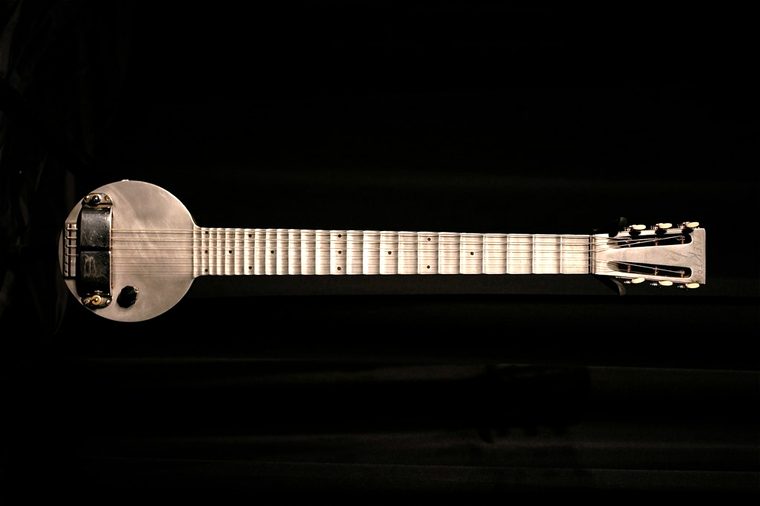
The “Frying Pan,” first commercially produced electric guitar
The Ro-Pat-In Electro A-25 (later Rickenbacker) is commercially produced. This aluminum-bodied lap steel guitar is widely considered the first successful commercially produced electric guitar, earning its nickname from its distinctive shape.
Historic firstCompetition emerges
Other manufacturers like Dobro and Vivi Tone introduce their own electric guitar models, signaling the start of a new industry.
Gibson enters the arena
Established companies like Gibson (with the ES-150, its first production electric guitar, famously used by Charlie Christian) and Epiphone begin producing electric guitars.
Gibson ES-150Beauchamp’s patent granted
George Beauchamp is granted a patent for his electric stringed musical instrument, though other companies had already entered the market by this point.
Charlie Christian, first electric guitar hero
Jazz guitarist Charlie Christian gains prominence with his amplified playing, becoming the first widely acclaimed electric guitar hero and demonstrating the instrument’s potential for soloing.
PioneerThe solid body revolution
Visionaries like Les Paul and Leo Fender transform the electric guitar from a hollow experiment into a precision instrument.
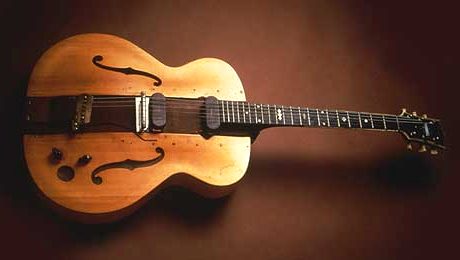
“The Log,” Les Paul’s solid body experiment
Les Paul begins experimenting with solid-body electric guitars, creating “The Log,” a 4×4 piece of lumber with guitar sides attached, effectively eliminating feedback issues common with hollow-body electrics. A pivotal moment in guitar history.
Game changerBigsby’s solid body for Merle Travis
Paul Bigsby builds a solid-body electric guitar for Merle Travis, one of the earliest solid-body guitars played by a major artist.
Fender Electric Instrument Co.
The Fender Electric Instrument Company is launched by Leo Fender, setting the stage for the most influential guitar brand in history.
FenderThe golden age
The decade that gave us the Telecaster, Les Paul, Stratocaster, and rock & roll itself. Every icon of electric guitar was born here.
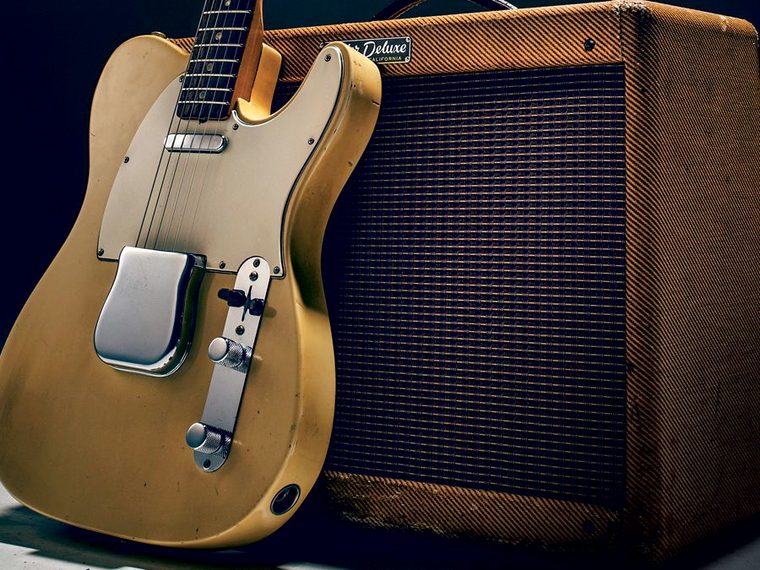
The Fender Telecaster, first mass-produced solid body
Leo Fender officially releases the Broadcaster (soon renamed the Telecaster), the first mass-produced solid-body electric guitar. It quickly gains popularity and remains one of the most beloved guitar designs ever made.
IconicFender Precision Bass
The Fender Precision Bass, the first widely recognized electric bass guitar, is introduced, forever changing rhythm sections in popular music.
Bass revolutionThe Gibson Les Paul
Gibson debuts its first solid-body electric guitar, the Les Paul Model, a collaboration with Les Paul himself, to compete with Fender’s growing success.
Gibson Les PaulGretsch Duo Jet
Gretsch releases the Duo Jet, their answer to the growing popularity of solid-body electrics. Though superficially resembling a solid body, the Duo Jet featured a chambered mahogany body, giving it a unique tonal resonance.
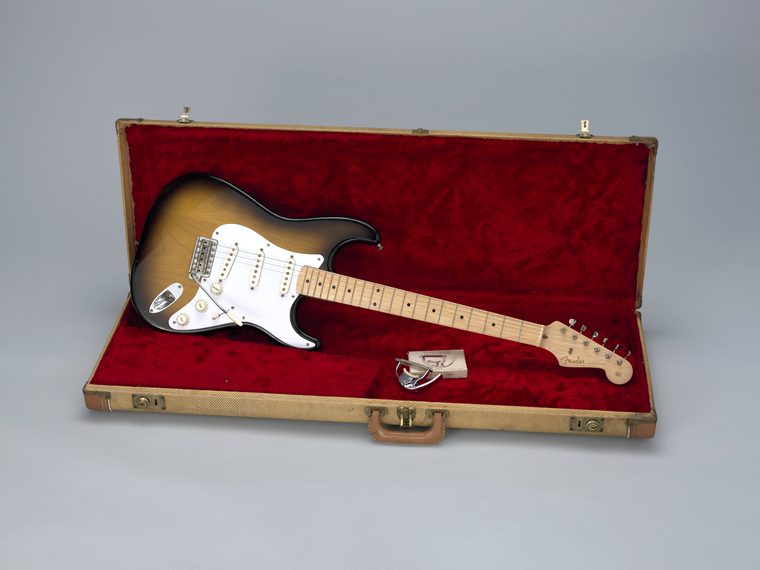
The Fender Stratocaster
Fender introduces the Stratocaster, designed by Leo Fender, George Fullerton, and Freddie Tavares. With its three pickups and innovative tremolo system, it becomes one of the most influential and iconic electric guitar designs in history.
LegendaryRock & roll takes the stage
The electric guitar becomes central to emerging genres like rock and roll, blues, and country, with musicians like Chuck Berry, Elvis Presley, Buddy Holly and others defining its sound.
Rock & rollGibson ES-335, Flying V & Explorer
Gibson introduces the influential ES-335 semi-acoustic model, along with the futuristic Flying V and Explorer, designs that would later become icons. The Les Paul also receives the humbucking pickup, improving its tone.
Design iconsFender Jazzmaster
Fender introduces the Jazzmaster, designed to appeal to jazz musicians with its warmer tone, unique offset body, and sophisticated tremolo system. While it didn’t initially catch on in jazz, it later found massive popularity within surf rock, alternative, and indie music.
Offset pioneerThe electric explosion
The British Invasion and Hendrix push the electric guitar beyond all known boundaries. An era of pure creative wildfire.
The British Invasion & beyond
The electric guitar continues its widespread expansion, driven by the British Invasion (The Beatles, The Who, etc.) and legendary players like Jimi Hendrix, who push the boundaries of its sound and performance.
Cultural revolution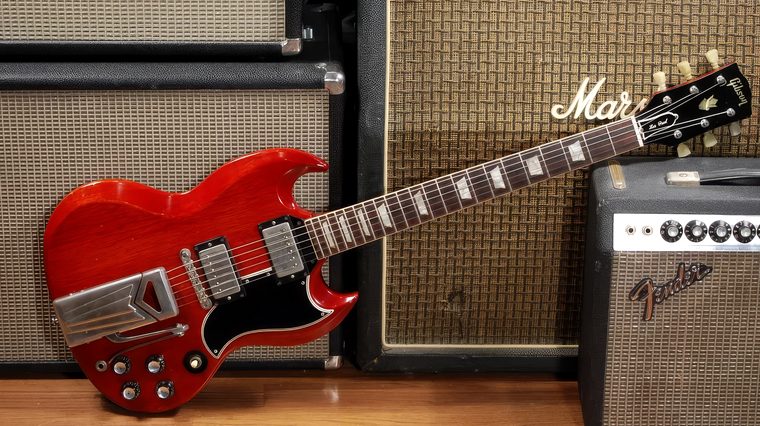
The Gibson SG
Gibson introduces the SG (Solid Guitar), originally intended as a redesign for the Les Paul model. With its lighter, thinner mahogany body, double-cutaway design, and faster neck, it offered a different feel and look. Though initially a “Les Paul,” it was officially renamed the SG in 1963 and became a highly successful and iconic model in its own right.
Gibson SGShred & innovation
The superstrat era. High-performance guitars with Floyd Rose tremolos, humbuckers, and speed-obsessed design philosophy.
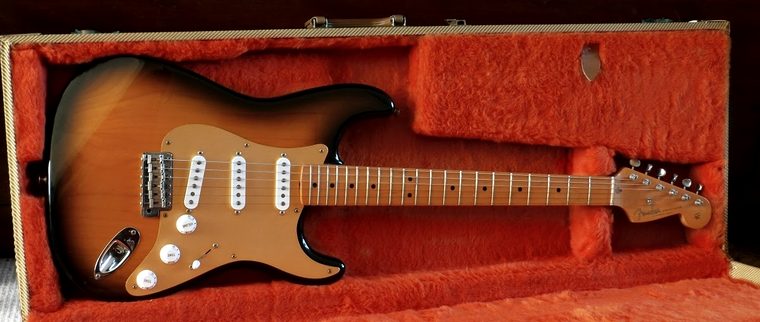
Rise of the superstrat
The electric guitar scene is dominated by the rise of “superstrats,” high-performance, often brightly colored guitars inspired by the Fender Stratocaster but featuring humbucking pickups, Floyd Rose tremolo systems (for extreme dive bombs and pitch modulation), and faster necks, catering to the demands of hard rock, heavy metal, and shred guitarists. Brands like Ibanez, Jackson, Charvel, and Kramer gain significant market share.
Superstrat eraGrunge & revival
A return to rawness. Vintage guitars reclaim the spotlight as grunge and alternative rock reject ‘80s excess.
Back to basics, vintage resurges
The guitar market sees a significant shift as grunge and alternative rock rise to prominence, leading to a renewed interest in more traditional, often vintage-inspired electric guitars, like Fender Jazzmasters, Jaguars, and Telecasters, and Gibson Les Pauls and SGs, moving away from the superstrats of the ‘80s. At the same time, the emergence of nu-metal and other heavy genres fuels the adoption of baritone and 7-string guitars, offering extended low-end range.
Vintage revivalThe digital age
Tradition meets technology. Vintage reissues, boutique builders, and digital modeling converge in the modern electric guitar landscape.
Vintage meets vanguard
The electric guitar landscape in the 2000s is characterized by several trends: a continued appreciation for vintage reissues and classic designs, the increasing popularity of boutique builders offering high-end custom instruments, and a growing emphasis on digital modeling amplifiers and effects, allowing guitarists to achieve a wide range of tones from a single setup. Extended-range guitars (7-string and 8-string) become more mainstream in metal genres, and signature models continue to be a significant part of manufacturer offerings.
Modern eraNearly a century of innovation, and the story is still being written.
From a 4×4 piece of lumber to the most iconic instrument in modern music, the electric guitar’s journey is far from over.
The best guitar is the one you can’t stop playing.
Don’t let myths dictate your choice. Trust your ears, your hands, and your budget, and play what feels right. Understanding the specs is valuable, but the instrument that makes you want to pick it up and play is always the right one. That’s what this guide is here to help you find.