While tonewoods get most of the attention, the way an acoustic guitar is built – particularly its internal bracing – plays a crucial role in determining how it sounds, responds, and holds up over time. Let’s look at the key aspects of guitar construction that affect tone and durability.
Bracing Patterns
Bracing refers to the system of wooden struts glued to the underside of the top (and sometimes back) of a guitar. These serve two critical functions:
- Controlling how the top vibrates, significantly affecting tone
- Providing structural support to withstand string tension
X-Bracing
What it is: The most common bracing pattern, featuring two braces that cross in an “X” shape beneath the soundhole.
Tonal characteristics: Balanced tone with good bass response and projection. Offers an excellent combination of structural integrity and resonance.
Variations: Forward-shifted X (X closer to soundhole), scalloped X (braces carved to remove mass while maintaining strength), and many other variations.
Fan Bracing
What it is: A series of braces radiating out from the area around the bridge, common on classical and flamenco guitars.
Tonal characteristics: More responsive to light touch, warmer tone, generally less projection than X-bracing.
Ladder Bracing
What it is: Horizontal braces running perpendicular to the strings, common on vintage guitars and some modern parlor models.
Tonal characteristics: Distinctive midrange focus, often described as having a “boxy” or “old-time” quality perfect for blues and folk styles.
Modern Alternative Bracing
What it is: Various proprietary systems developed by manufacturers, including Taylor’s V-Class, Martin’s Tone Tension, and others.
Tonal goals: Often aimed at improving sustain, intonation, volume, or bass response beyond traditional designs.
My experience: The bracing inside a guitar makes a huge difference in how it sounds and responds. When guitar makers modify the bracing pattern by scalloping or using different designs, they’re essentially voicing the top to vibrate in specific ways. I’ve seen this firsthand when comparing similar models with different bracing patterns – the difference can be as significant as changing the wood type.
Body Construction Methods
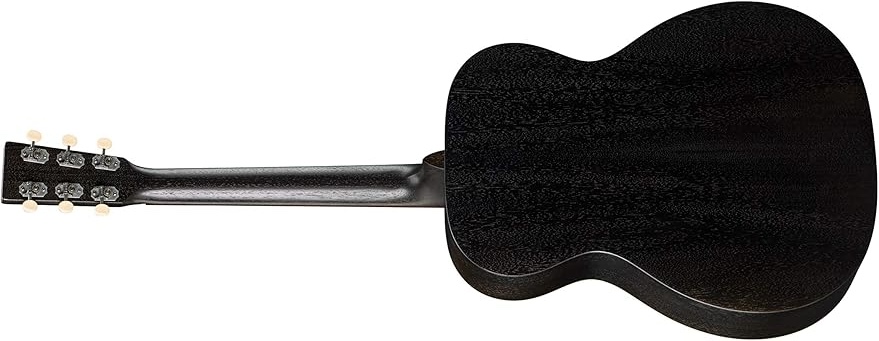
Traditional Dovetail Neck Joint
What it is: The neck and body are joined using a precisely carved dovetail joint, secured with glue.
Tonal implications: Believed by many to provide superior resonance and sustain due to the large, tight-fitting contact area.
Bolt-On Neck
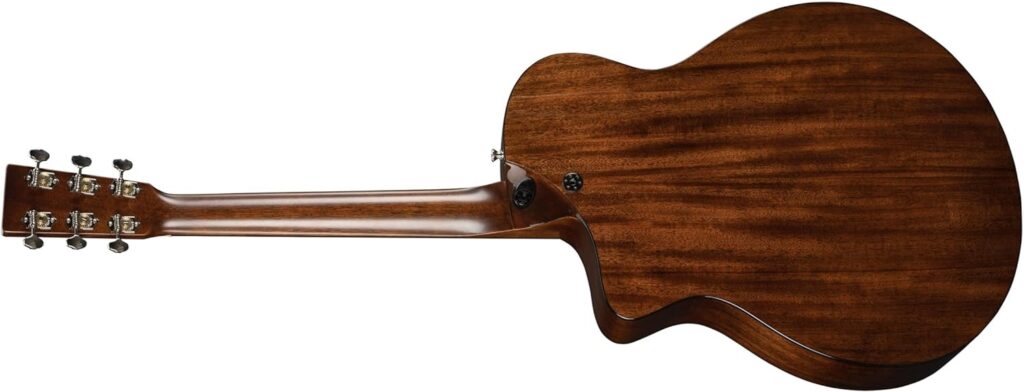
What it is: The neck is attached to the body using bolts (typically hidden inside the guitar).
Advantages: Easier to adjust or reset if needed, consistent manufacturing process.
Tonal considerations: Some traditionalists believe it doesn’t transfer vibration as well as a dovetail, though the difference is debated.
Integral Neck
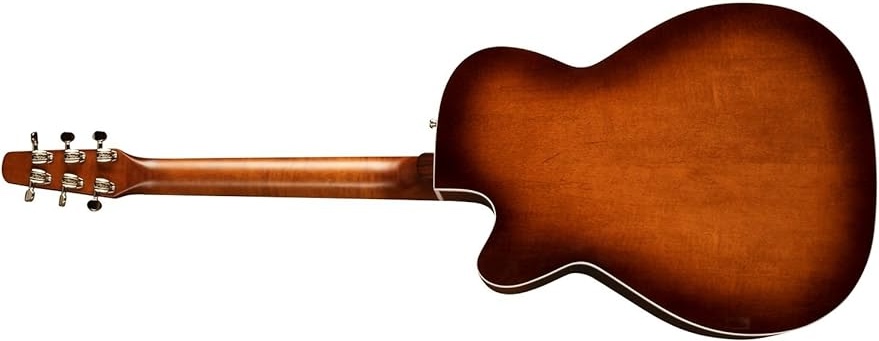
What it is: The neck and neck block of the body are carved from a single piece of wood.
Tonal benefits: Excellent vibration transfer between neck and body, potentially enhancing sustain.
Other Construction Elements
Scale Length
What it is: The vibrating length of the strings, measured from the nut to the saddle.
Common measurements:
- Short scale (24″ to 24.75″): Easier string tension, warmer tone
- Medium scale (25″ to 25.5″): Balanced tone and tension
- Long scale (over 25.5″): Tighter string tension, brighter tone
Impact on sound and feel: Scale length affects not just playability but also tone. Generally, shorter scales have lower string tension, making bending easier, while longer scales provide more brightness and articulation.
Body Depth
What it is: The thickness of the guitar’s body, which varies by model and maker.
Tonal impact: Greater depth generally increases bass response and overall volume.
Binding and Purfling
What they are: Decorative elements around the edges of the guitar top, back, and sometimes the fretboard.
Construction relevance: Beyond aesthetics, binding protects the vulnerable edges of the guitar from damage.
Finish
Types: Nitrocellulose lacquer, polyurethane, polyester, water-based finishes.
Tonal considerations: Thinner finishes generally allow more vibration, while thicker finishes provide more protection.
Solid vs. Laminate Construction
We covered the tonal aspects of solid vs. laminate woods earlier, but there are also important construction considerations:
Solid Wood Construction
Advantages:
- Superior resonance and tone that improves with age
- Generally lasts longer when properly cared for
- Higher resale value
Disadvantages:
- More susceptible to humidity changes
- Significantly more expensive
- Requires more careful maintenance
Laminate (Layered) Construction
Advantages:
- More stable in variable environmental conditions
- More resistant to cracking and damage
- Much more affordable
Disadvantages:
- Doesn’t improve with age
- Limited resonance, especially in the top
- Lower resale value
My experience: Construction quality is incredibly important, regardless of price point. Even in budget guitars, I look for solid build quality first and foremost. You can see some of my thoughts on budget guitars in my video“How bad are cheap guitars? // I tested 4 affordable models”.
Common Finish Types
Nitrocellulose Lacquer (Nitro)
Common Use: The traditional finish, especially on vintage and many high-end instruments. It’s a type of plastic dissolved in a solvent, applied in many thin coats.
Tone Contribution: Highly regarded for its “thin” and “breathable” qualities. It allows the wood to resonate more freely, contributing to a more open, resonant, and often warmer tone with excellent sustain. Many players feel it “ages” with the guitar, becoming thinner and harder over time, allowing the wood’s resonance to develop further.
Feel: Feels very natural and comfortable under the hand. It can develop a lovely patina over time, sometimes “checking” (fine cracks in the finish) with temperature changes, which some see as character.
Durability: Less durable than modern poly finishes. It’s softer, so it’s more susceptible to dings, scratches, and chemical reactions (e.g., from some guitar stands, bug spray, sweat).
Aesthetics: Often has a beautiful, deep gloss that mellows slightly over time. Ages gracefully.
Best For: Players who prioritize vintage aesthetics, maximum resonance, and are willing to accept a more delicate finish that requires a bit more care.
Polyurethane (Poly) / Polyester
Common Use: The most common modern finish, found on the vast majority of guitars from budget to high-end. It’s a very durable plastic-based finish, applied often in fewer, thicker coats.
Tone Contribution: Generally denser and harder than nitro. While modern poly finishes are incredibly sophisticated and much thinner than they used to be (some are very thin!), a thicker poly finish can slightly dampen the wood’s natural resonance compared to a very thin nitro or French polish. However, many excellent-sounding guitars have poly finishes, especially modern, thin poly finishes. Consistency is a key benefit.
Feel: Can feel very smooth and slick, sometimes almost like glass, especially on the neck. It’s very resistant to stickiness.
Durability: Extremely durable, resistant to dings, scratches, and environmental factors. It’s a workhorse finish.
Aesthetics: Can achieve a very consistent, high-gloss, pristine look. Does not age or “check” like nitro.
Best For: Players who need maximum durability, consistency, and a low-maintenance finish. Great for gigging musicians or those who just want a guitar that can take a beating.
French Polish
Common Use: Primarily found on classical guitars, very high-end boutique acoustics, and some custom instruments. It’s a very thin, hand-applied shellac finish.
Tone Contribution: Considered the “thinnest” and most resonant finish available. It allows the wood to vibrate almost entirely unrestricted, resulting in incredible volume, projection, and harmonic richness. It’s like the guitar is naked but with a protective sheen.
Feel: Incredibly natural, almost like bare wood but silky smooth.
Durability: Extremely delicate. It’s the least durable finish and is very susceptible to scratches, dings, sweat, and environmental changes. Requires significant care.
Aesthetics: A very subtle, natural luster that highlights the wood grain beautifully.
Best For: Players seeking absolute maximum resonance, projection, and tonal purity, often at the expense of durability. Demands a high level of care.
Oil Finish (e.g., Tung Oil, Linseed Oil)
Common Use: Less common on full acoustic guitar bodies, but sometimes used on necks or specialized boutique instruments. More common on electric guitar necks.
Tone Contribution: Allows the wood to breathe very freely, providing a natural, open, and often warm tone. Very minimal dampening.
Feel: Feels very natural, like bare wood, but sealed. Can be smooth and comfortable.
Durability: Offers less protection against dings and moisture than lacquer or poly, but can be easily repaired and re-applied.
Aesthetics: A natural, satin-like luster that highlights the wood’s beauty without a thick glossy coat.
Best For: Players prioritizing a very natural feel and open tone, willing to accept less protection and potentially more maintenance.
Handmade vs. Factory-Built
Handmade Instruments
Characteristics: Built by individual luthiers or small teams with extensive hand work.
Advantages: Meticulous attention to detail, often built to customer specifications, potential for unique tonal qualities.
Considerations: Significantly higher cost, longer wait times, more variability between instruments.
Builders to consider: Collings, Santa Cruz, Bourgeois, Furch, Lowden
Factory-Built Instruments
Characteristics: Built in larger facilities with a combination of machine and hand work.
Advantages: Consistency between instruments, generally more affordable, more readily available.
Considerations: Less customization, potentially less individual attention to tonal optimization.
Brands to consider: Martin, Taylor, Gibson, Eastman, Yamaha
Construction Decision Tree
Start with your priorities:
- Is tone your primary concern? → Prioritize solid woods, traditional bracing, possibly dovetail neck
- Is durability/stability a major factor? → Consider laminate back/sides, modern neck joints, more durable finishes
- Is value for money most important? → Focus on solid top with laminate back/sides, simpler appointments
Consider your environment:
- Do you live in a very dry or humid climate? → Laminate construction may be more stable
- Will the guitar be exposed to temperature changes? → Consider synthetic materials or laminate construction
Think about long-term maintenance:
- Are you comfortable paying for a neck reset someday? → Dovetail joints typically require more expensive resets
- Do you prefer easy adjustment options? → Bolt-on necks offer more straightforward maintenance
A Personal Note on Construction
There’s undeniable magic in traditionally-built instruments with their dovetail neck joints and classic X-bracing. At the same time, modern construction techniques have solved real problems. Taylor’s bolt-on necks make maintenance simpler, and their V-Class bracing has genuinely improved intonation.
The most important thing is how the guitar sounds and feels to you. Sometimes we can get caught up in specifications and construction details, but ultimately, it’s about finding an instrument that inspires you to play. Trust your ears and hands over any spec sheet.